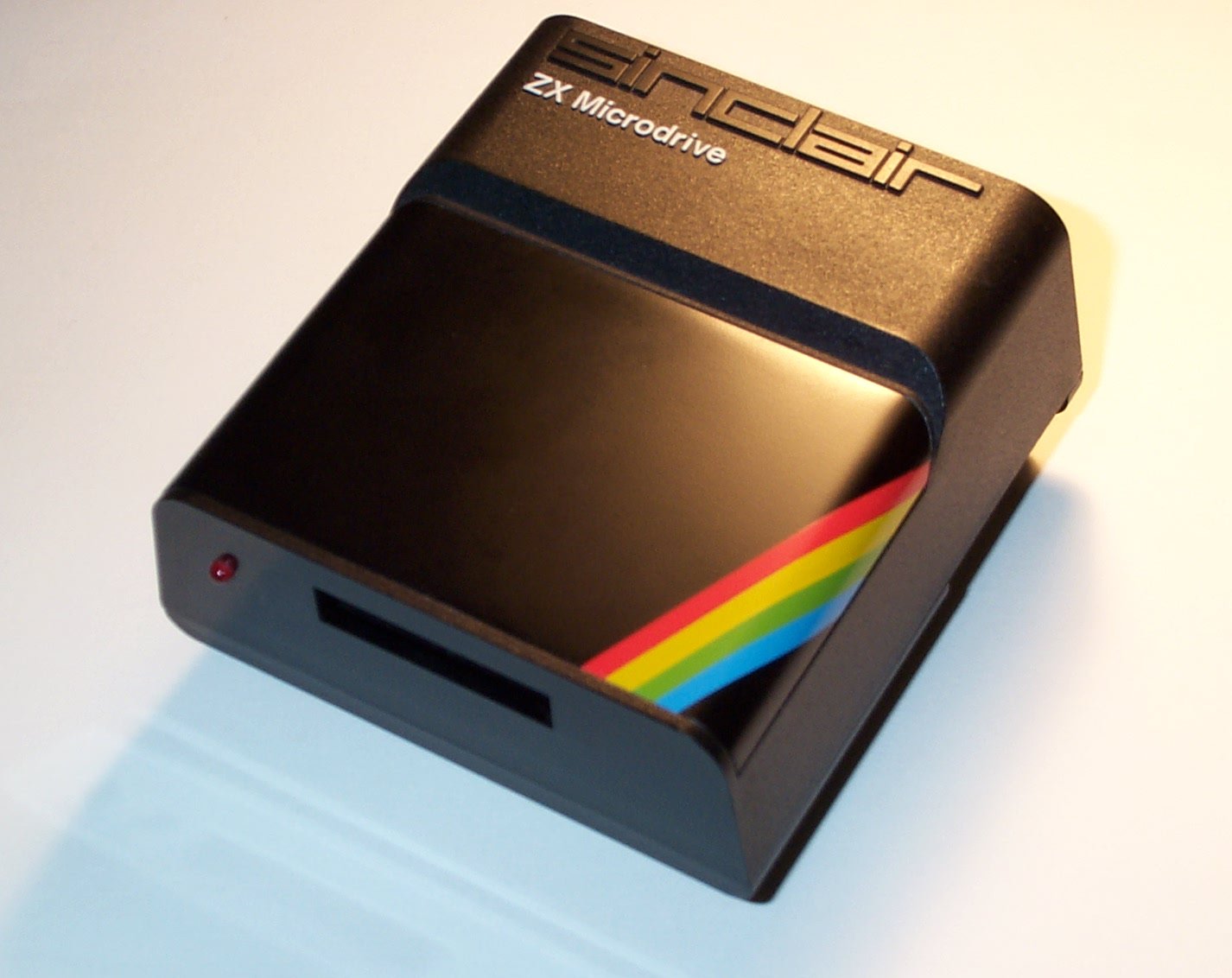
Not to be confused with the IBM/Hitachi Microdrive of 1999, the 1-inch hard disk in CompactFlash cards, which has its own exhibit in this museum. This is the Sinclair ZX Microdrive of 1983: a tape drive.
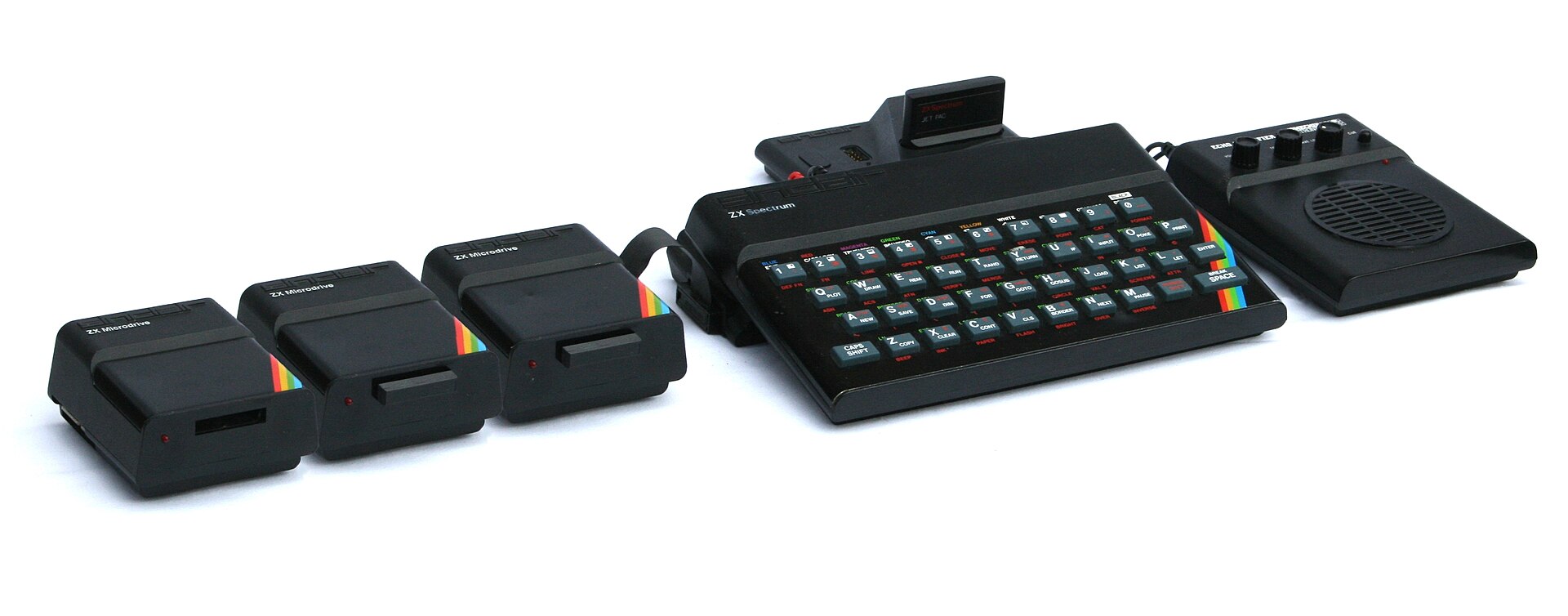
Clive Sinclair’s Microdrive put a five-metre loop of tape into a cartridge the size of a matchbook, with a small drive that cost £49.95. The loop never rewound; the drive ran it past the head and a file came round in a few seconds, not the minutes of a cassette load. It was announced in April 1982 as a 100 KB device that would “change the face of personal computing.” It shipped in September 1983 after an 18-month delay, at a minimum of 85 KB per cartridge, and it needed a separate £49.95 ZX Interface 1 to talk to the Spectrum. The Register counts fewer than 1,000 sold by early 1984. Sinclair then built two into every QL, the 1984 business machine, and made them its only software medium.
They failed in the ordinary way. The tape stretched and oxide built up on the head, and software houses balked at a medium that cost over six times what a cassette did to make. Sinclair cut cartridge prices from £4.95 to £1.99 in early 1985. By then UK QL production had been suspended, and on 7 April 1986 Amstrad bought the Sinclair computer lines for £5 million. The QL was discontinued, Amstrad dropped the Microdrive, and the Spectrum +3 of 1987 shipped with a 3-inch floppy drive instead. Hobbyists now run SD-card emulators in the expansion port, because the working cartridges are running out.
Sinclair picked the cheapest storage for a mass market, and disk drives kept getting cheaper while he shipped, until a floppy cost no more than his loop of tape.
Worth remembering
- Each cartridge held a 5-metre loop of tape and took about 8 seconds to make one full circuit.
- Sinclair promised 100 KB per cartridge and shipped at a minimum of 85 KB; the drive cost £49.95 but needed a £49.95 Interface 1 (£79.95 bundled).
- The Register reports fewer than 1,000 Microdrives sold by early 1984, after an announcement in April 1982 and a shipping date of September 1983.
The people
-
Clive Sinclair — Founder of Sinclair Research, 1940–2021
Said the Microdrive would 'change the face of personal computing'.
Gallery
Further reading
Sources
- Launched in 1983 by Sinclair Research for the ZX Spectrum; cartridges hold a 5-metre endless loop of tape, minimum 85 KB formatted, about 8 seconds per full circuit; needed the £49.95 ZX Interface 1 (or £79.95 bundled); up to eight drives could be chained; QL had two internal drives Wikipedia
- Announced 23 April 1982 at Earl's Court, shipped September 1983 after an 18-month delay; drive £49.95, cartridges £4.95 cut to £1.99 in early 1985; promised 100 KB, shipped at 85 KB; tape stretch and oxide problems; Amstrad discontinued Microdrive support and promoted its 3-inch disk The Register
- Sinclair QL launched 12 January 1984, about 150,000 sold, Microdrive reliability problems, cartridges were the only QL distribution medium at over six times the production cost of a compact cassette; UK production suspended in 1985; QL officially discontinued after Amstrad's April 1986 acquisition Wikipedia
- On 7 April 1986 Amstrad bought the Sinclair brand and rights to Sinclair computers and computer products for £5 million Computing History
- Amstrad bought the Microdrive rights but abandoned it; the 1987 Spectrum +3 used Amstrad's 3-inch disk drive instead Sinclair computers archive (NTNU)
Leave a flower to show you came, and remembered.