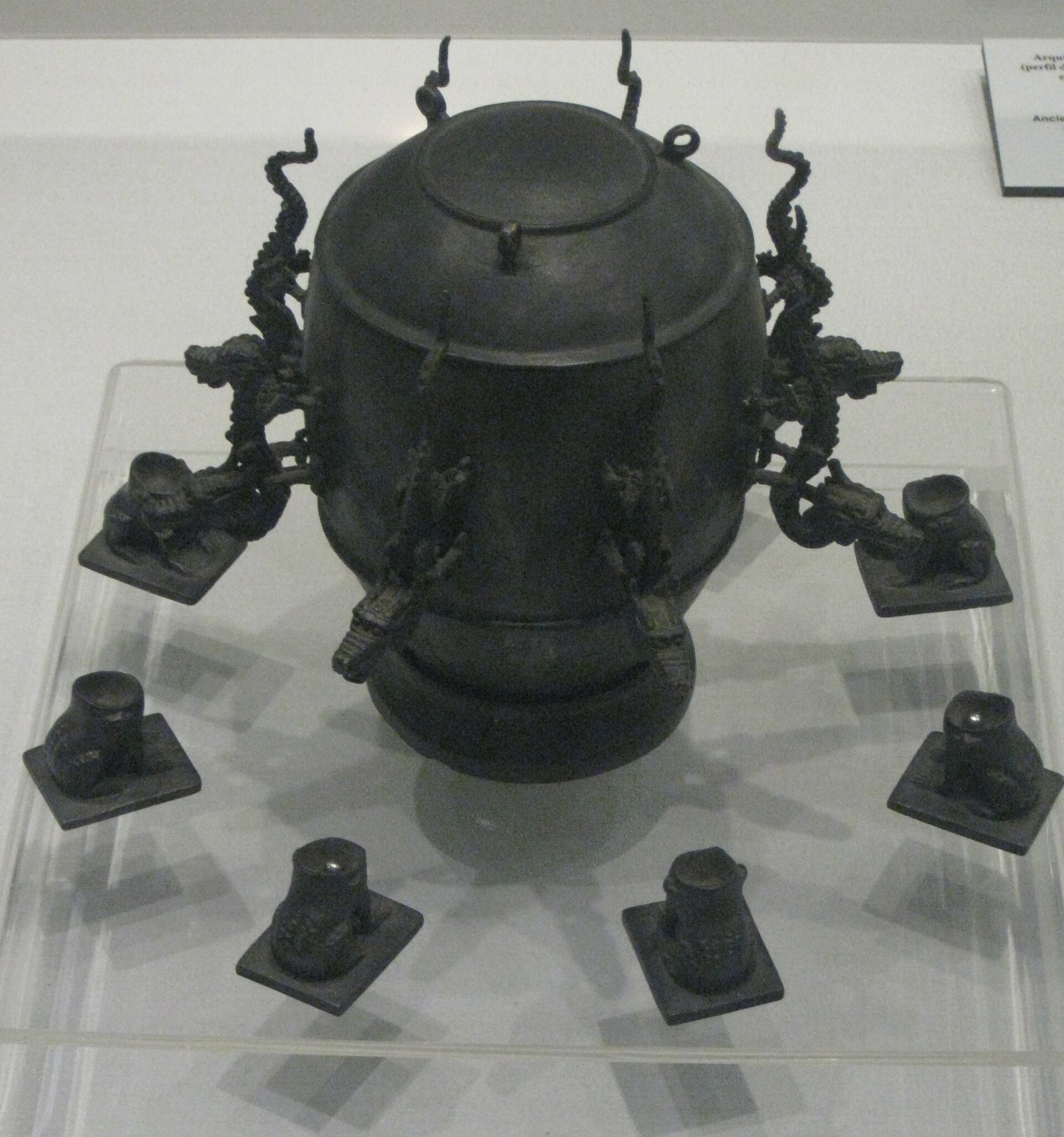
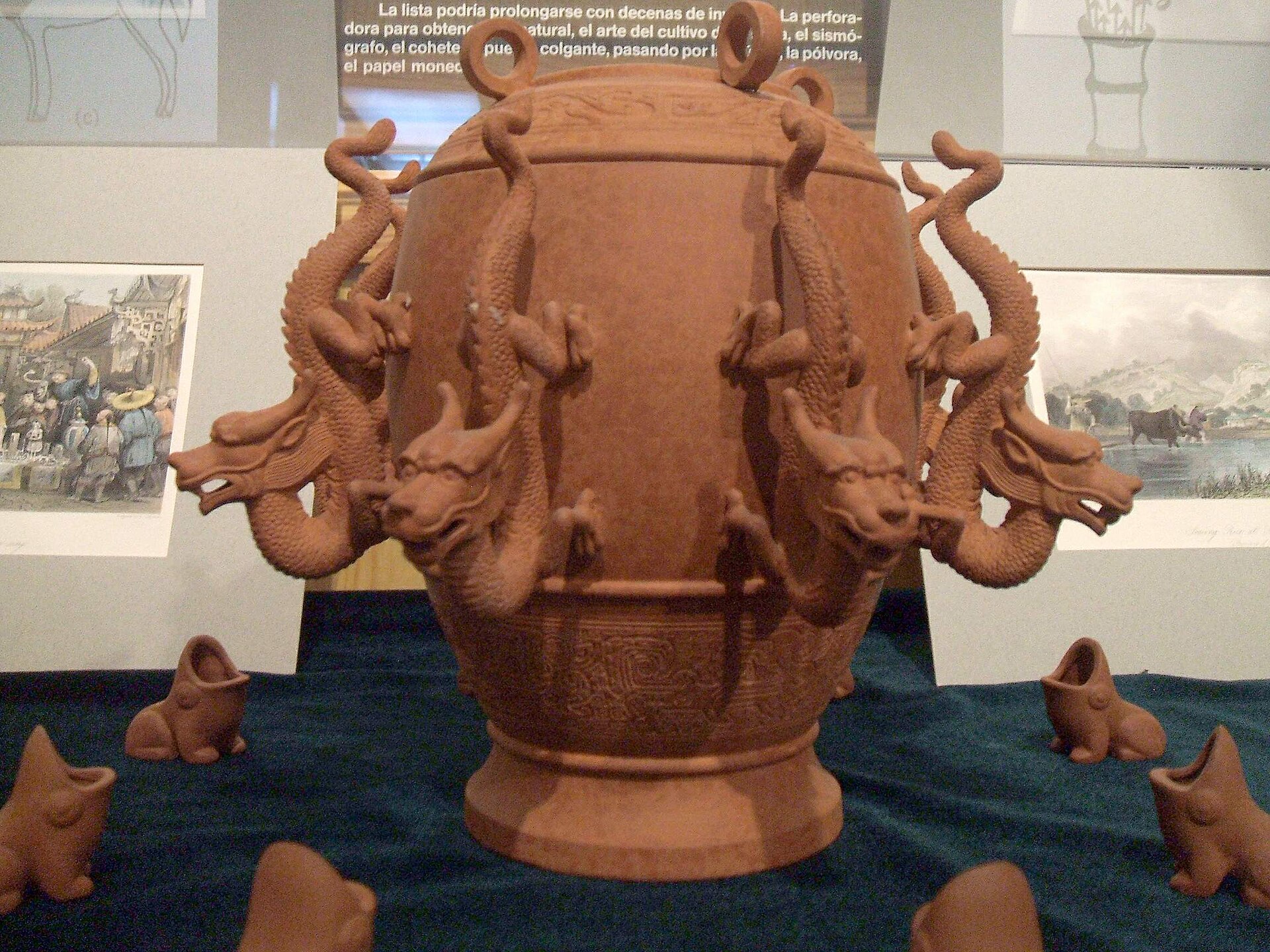
In the autumn of 132 CE, the court historian Zhang Heng finished a bronze vessel the Hou Han Shu calls the Houfeng Didong Yi. It was eight chi across, about two metres, and shaped like a wine vessel. Eight dragons faced the compass points, each holding a bronze ball over a toad with its mouth open. When the ground shook, one ball fell into a toad with a noise loud enough for an attendant to hear, and the dragon that had dropped it pointed toward the quake. The text says only that the mechanism lay hidden inside and names a central pillar and eight rods. Hong-Sen Yan, writing in 2007, calls the record of the interior too short to say how it worked.
The text tells of one test. A dragon dropped its ball, no one in the capital felt anything, and the scholars of the city found the instrument useless. Several days later a courier reported an earthquake in Longxi. After that the court had the historian record which direction each quake came from. Zhang Heng died in 139.
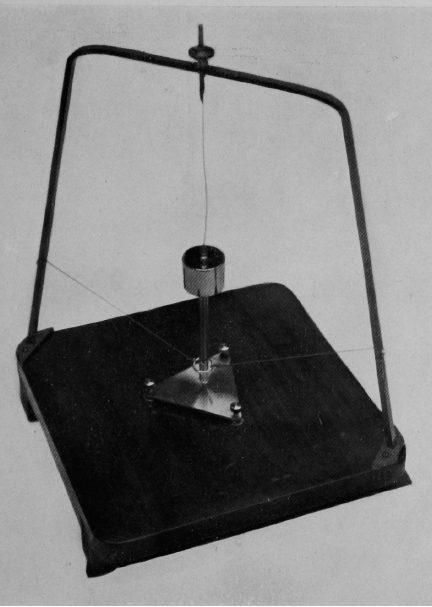
The instrument itself is gone. The Henan Museum says it was probably lost after the Yongjia disorder of 307-312, an inference with no record of the moment. Two later works that described it, the Northern Qi Qizhun and the early-Sui Didong Tongyi Jing, are also lost, and by about 1290 Zhou Mi could not find the books on such devices by Xindu Fang and Lin Xiaogong. Every modern version is a guess from the same 196 characters. Wang Zhenduo proposed a suspended pendulum in 1936 and an inverted one in 1963, Imamura and Hagiwara built one in Tokyo in 1939, and Chinese seismologists announced another in 2005. The replicas fall short of the accuracy the records describe.
Worth remembering
- The vessel was cast of bronze, 8 chi (about 2 metres) across, with eight dragon heads around the outside, each holding a bronze ball over an open-mouthed toad.
- Only one dragon dropped its ball per earthquake; the direction that dragon faced was read as the direction the shaking came from.
- It once dropped a ball when nobody in the capital felt a tremor. Scholars called it a failure until a courier days later reported an earthquake in Longxi, after which the court told the historian to log quake directions.
Gallery
Further reading
Sources
- Hou Han Shu text as translated by Yan: Zhang Heng built the Houfeng Didong Yi in autumn of the first year of Yangjia (132 CE); the bronze vessel was 8 chi in diameter (about 2 metres), shaped like a wine vessel, with a central pillar, eight transmitting rods, eight dragons with bronze balls in their mouths and a toad beneath each; one ball dropped per earthquake, showing the direction H. S. Yan, Journal of Asian Earthquake Engineering (2007)
- Once a dragon released a ball with no earthquake felt in the capital, scholars doubted it, and several days later a courier arrived reporting an earthquake in Longxi; after that the court ordered the historian to record the direction of quakes H. S. Yan, Journal of Asian Earthquake Engineering (2007)
- Zhang Heng died in 139 CE; there are no clear historical documents and physical remains of the seismoscope, and the interior records are too short to show the real mechanism; the Hou Han Shu passage runs to 196 characters H. S. Yan, Journal of Asian Earthquake Engineering (2007)
- The seismoscope did not survive and was probably lost after the Yongjia disorder (307-312 CE); the Northern Qi Qizhun and early-Sui Didong Tongyi Jing, which described it, are both lost Henan Museum
- Around 1290 Zhou Mi noted that books by Xindu Fang and Lin Xiaogong describing seismological devices could no longer be found Wikipedia
- Reconstruction attempts: Wang Zhenduo proposed a suspended-pendulum model in 1936 and an inverted-pendulum model in 1963; Imamura and Hagiwara built one at Tokyo University in 1939; Chinese seismologists announced a replica on 13 June 2005; modern replicas fall short of the accuracy described in historical records Wikipedia
- Maragheh observatory (founded 1259) had seismographic devices but it is unclear whether they relate to Zhang Heng's; Hautefeuille described a mercury-bowl seismoscope in 1703 with no evidence he built one Wikipedia
Leave a flower to show you came, and remembered.