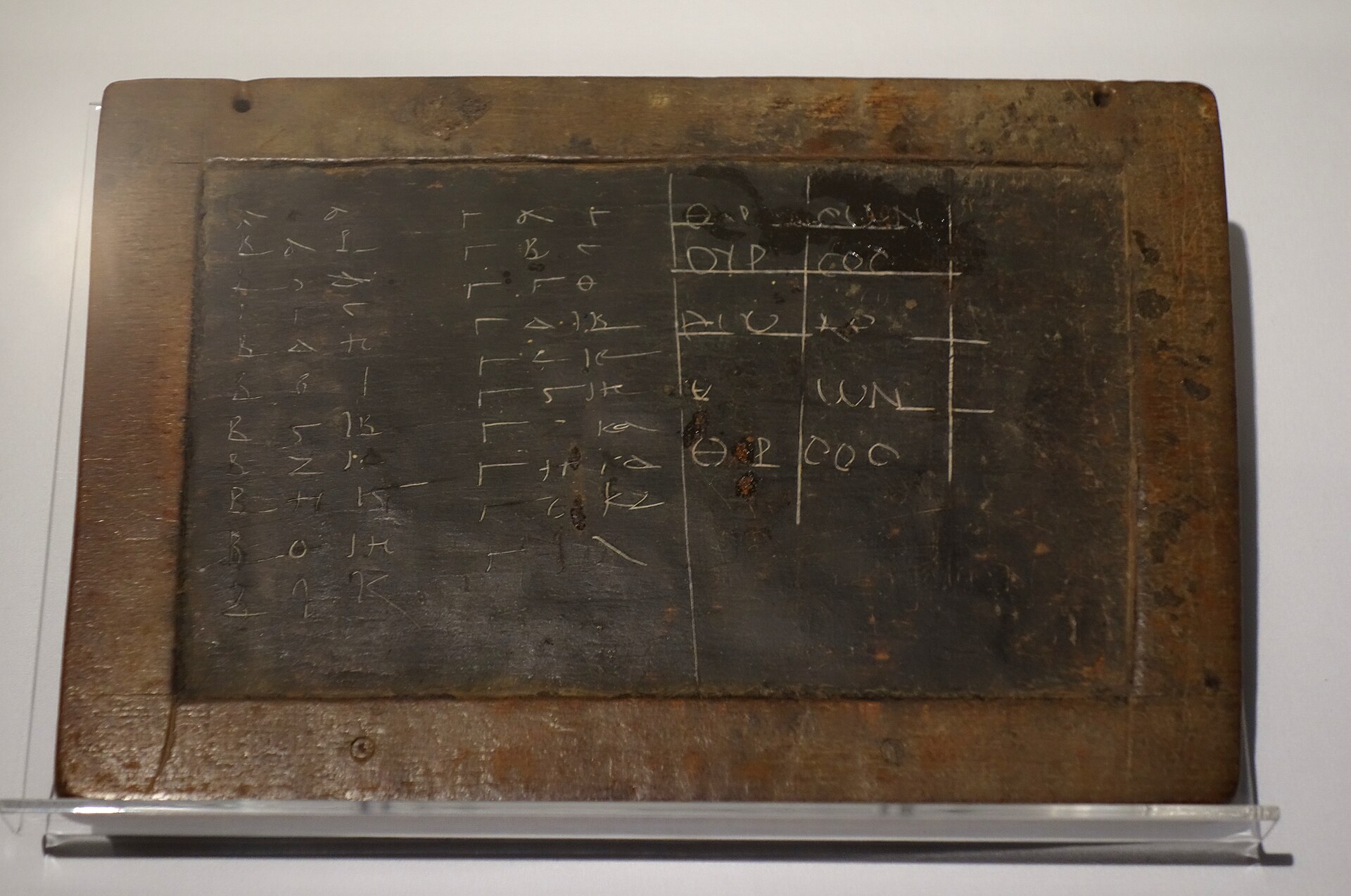
The oldest surviving writing tablet is a boxwood folding board, 9.5 x 6.2 cm, with ivory hinges, recovered from the Uluburun shipwreck off the Turkish coast. The wreck dates to 1320 BCE, give or take 15 years. The tablet likely had wax surfaces, though no wax is reported from it. Greeks were using folding wax tablets by about the mid-8th century BCE, and Romans used them for drafts, accounts, letters, shorthand records of Senate debates, and from 139 BCE as ballots. In London, the Bloomberg excavation of 2010 to 2013 recovered 405 wooden tablets from waterlogged ground, 181 of them stylus tablets. Of the 90 translated, 43 are general correspondence and 25 are financial or legal documents.
The wax tablet outlived Rome by more than a thousand years. Élisabeth Lalou writes that wax was a common writing support in Western Europe until the 16th century and residual until the 19th; cheap paper squeezed it out of everything but jobs where a record only had to last the day. The best-documented late case is Rouen. The BnF holds a wood-and-wax tablet dated 1849, 48.5 x 19.5 cm, used to display the bids at the fish auction. Its users called it “Moïse”.
The BnF says the practice lasted until new market halls were built in 1864. The archaeologist Thaurin, in the Journal de Rouen of 15 February 1866, reports the auction still recording awards on wax with a polished soft-iron stylus, “in the ancient method of the Romans”. That report is the latest dated use on record here, so the end is dated to the 1860s. Reproductions are made for re-enactors and classrooms.
Worth remembering
- The oldest surviving example, from the Uluburun shipwreck (wreck dated 1320 +/-15 years BCE), is a folding boxwood tablet 9.5 x 6.2 cm with ivory hinges.
- The Bloomberg excavation in London produced 405 wooden tablets from 2010 to 2013, of which 181 are stylus (wax) tablets. One carries the earliest known mention of London's name.
- At the Rouen fish auction, bids were recorded on a 48.5 x 19.5 cm wax board nicknamed 'Moïse'. An 1866 newspaper report described the method as that of the Romans.
Gallery
Further reading
Sources
- Earliest surviving example is a boxwood writing tablet with ivory hinge from the Uluburun shipwreck; Greeks used folding wax tablets from about the mid-8th century BCE; wax records were used for transient business records until the 19th century; the fish market at Rouen used them until the 1860s Wikipedia
- The Uluburun tablet is a small folding boxwood writing tablet, 9.5 x 6.2 cm, with partly surviving ivory hinges; the wreck dates to 1320 +/-15 years BCE; the tablet likely had wax surfaces (no wax reported) Wikipedia
- Rouen fish-market tablet dated 1849, wood and wax with leather handle, 48.5 x 19.5 cm, nicknamed 'Moïse', used to display bids at the fish auction; the practice continued until the new market halls were built in 1864 Bibliothèque nationale de France
- The archaeologist Thaurin wrote in the Journal de Rouen of 15 February 1866 that the Rouen fish auction still recorded awards on wax tablets with a polished soft-iron stylus, 'selon la méthode antique des Romains' Annales de Normandie (A. Dubuc, 1959), via Persée
- Wax was a common writing support in Western Europe until the 16th century and its use was residual until the 19th century Bibliothèque de l'École des chartes (É. Lalou, 1989), via Persée
- Use declined as cheaper paper and ink spread; Romans used tablets for drafts, accounts and letters, single tablets as ballots from 139 BCE, and senate secretaries for shorthand Wikipedia (French)
- Bloomberg site, London: 405 wooden tablets found 2010-13 in waterlogged Walbrook mud; 181 stylus (wax) tablets, 90 of them translated: 43 general correspondence, 25 financial or legal, 8 bookkeeping, 14 miscellaneous; one tablet holds the earliest known mention of London's name Wikipedia
Leave a flower to show you came, and remembered.