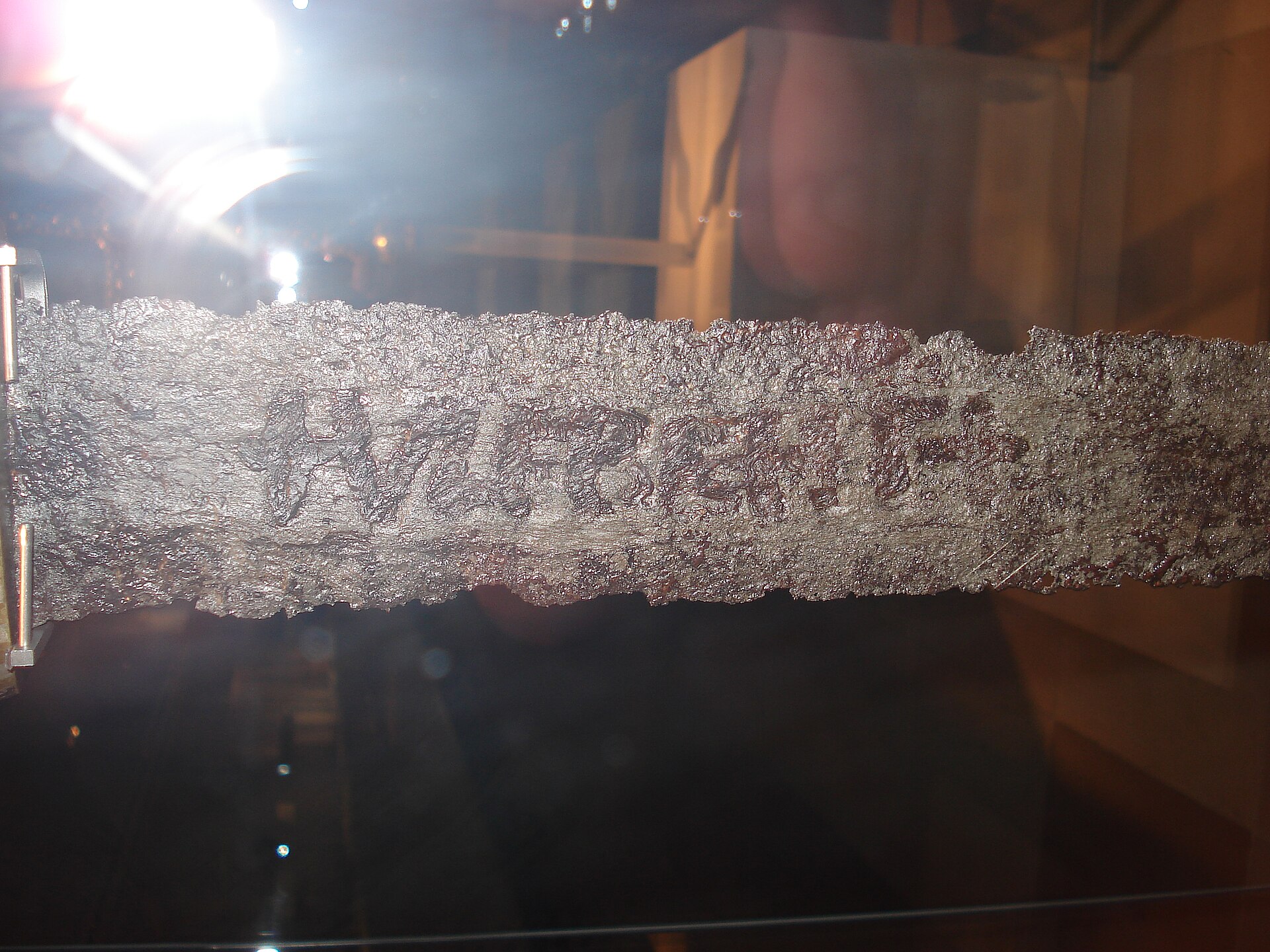
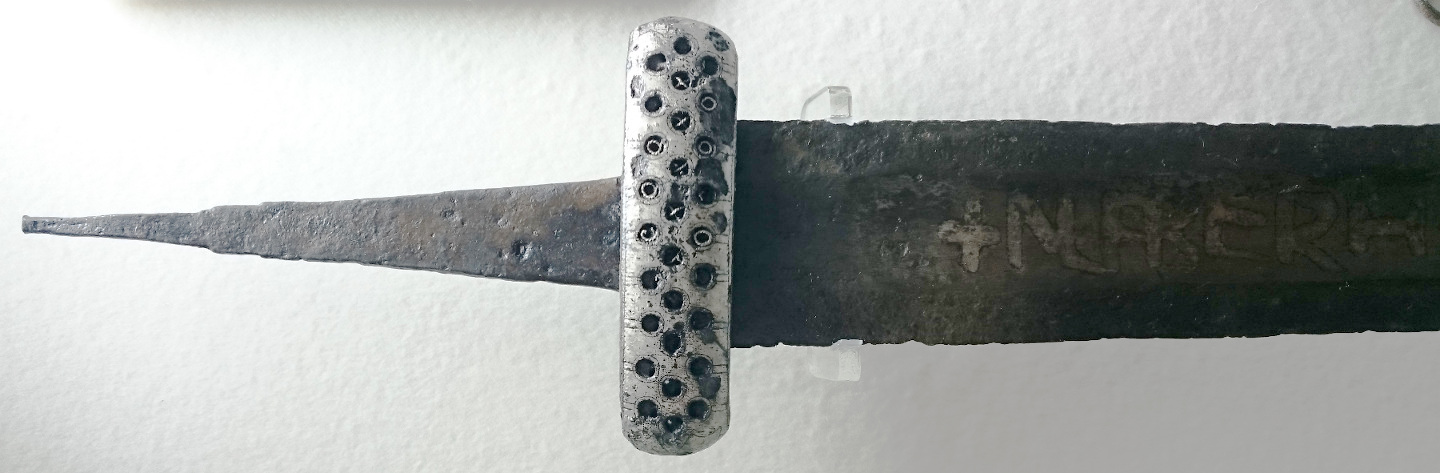
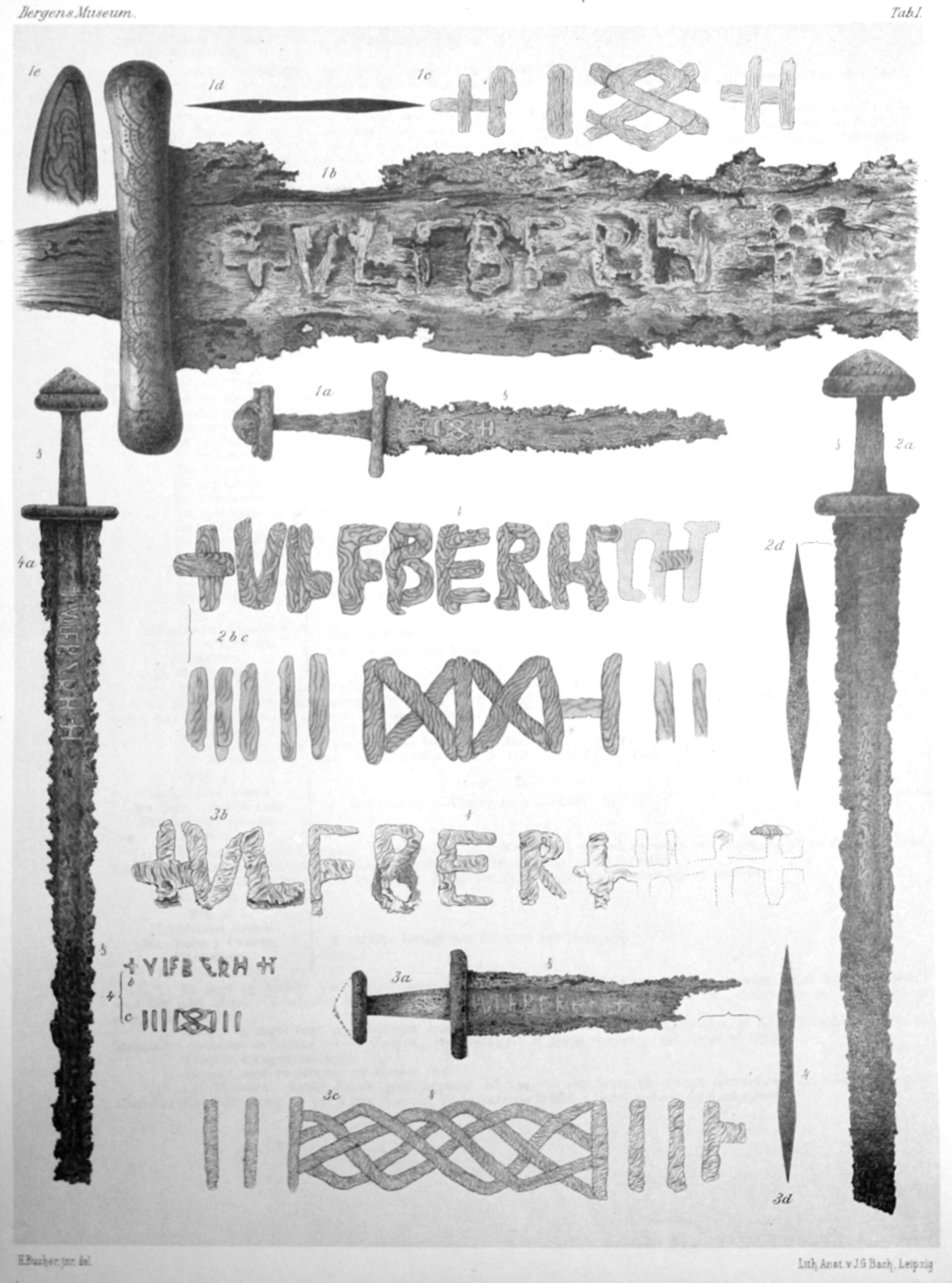
An Ulfberht sword carries the name +VLFBERH+T inlaid in its blade. Between 166 and 171 of them survive, depending on who counts: Wikipedia gives 167, Anne Stalsberg 166, and KPBS 171. Norway has the most, 44, followed by Sweden with 17, Finland with 14, Germany with 13 and Russia with 11. They were most likely made in the Rhineland, and they are dated by their hilts from around AD 800 through the 11th century. Carolingian law forbade selling swords to foreigners.
The name appears on blades of very different quality. Alan Williams, a consultant to the Wallace Collection, graded 55 of them by carbon content. Nine fell in the top grade, above 0.8% carbon, and 11 in the bottom grade, under 0.2%. Williams proposed that the best were made from crucible steel imported from Central Asia along the Baltic-Iran trade route. He and Tony Fry of the National Physical Laboratory also found that the name was copied: misspelled inscriptions turn up on blades that contain none of the high-carbon steel. Ingo Petri, who examined 17 blades and published in 2019, found layered raw material typical of European iron and steel production and concluded that it most likely came from Europe. The sources do not agree on where the steel came from.
The inscribed blades stop in the 11th century. No Norwegian example is dated later than the early-middle 11th century, and the latest one, from eastern Germany, is dated 11th or possibly early 12th century and carries a Christian invocation beside the signature. Williams says production stopped when the trade route closed and that no sword examined from after 1000 CE contains the same steel. Wikipedia notes that larger steel blooms became available after 1000. In 2012 the blacksmith Ric Furrer made an Ulfberht for NOVA, which described it as the first metallurgically accurate attempt in about a thousand years.
Worth remembering
- Carolingian capitularies made it illegal to sell swords to foreigners, yet Norway has the most known Ulfberht blades, 44 of the 167 on Wikipedia's count.
- The blades do not share one standard. Williams graded 55 of them by carbon content: 9 above 0.8% carbon at the top, 11 under 0.2% at the bottom.
- Three Ulfberht swords were found in Volga Bulgaria, on the Volga trade route. One is in the Historical Museum in Kazan.
Gallery
Further reading
Sources
- Blades are inlaid +VLFBERH+T or +VLFBERHT+; Wikipedia counts 167 (table sum 168), with Norway 44, Sweden 17, Finland 14, Germany 13, Russia 11 Wikipedia
- Swords with the inscription were made at least until the end of the Viking Age in the 11th century; none of the Norwegian examples is dated later than the early-middle 11th century; a late eastern German example, 11th or possibly early 12th century, is the only one combining the signature with a Christian 'in nomine domini' inscription Wikipedia
- The swords most likely originated in the Rhineland; Carolingian capitularies made it illegal to sell swords to foreigners; three examples were found in Volga Bulgaria; after AD 1000 larger steel blooms became available Wikipedia
- About 170 known Ulfberht swords (Stalsberg counted 166); blades date from around AD 800 to the 11th century, possibly the 12th; Williams's five grades by carbon content (Grade 1 above 0.8% C; Grade 5 below 0.2%) over 55 swords, with counts 9, 5, 14, 16, 11; Williams's Eastern origin for the steel is disputed Christian-Albrechts-Universität Kiel, Faculty of Engineering
- Some Ulfberht-type swords are hypereutectoid steel unlike other Western European swords; Williams suggests Central Asian crucible steel; production stopped when the Baltic-Iran trade route closed; many counterfeit swords with misspelled versions exist; none of these, and no later medieval swords examined (after 1000 CE), contain hypereutectoid steel Alan Williams, Metals and Civilizations (BUMA VII, 2015), via ISEA Archaeobib
- Ingo Petri examined 17 blades, 3 of which Williams had also studied; he found layered raw material typical of European iron and steel production and concluded the raw material most likely came from Europe The Sword: Form and Thought, ch. 5 (Boydell, 2019), via Cambridge Core
- Alan Williams (consultant to the Wallace Collection) and Tony Fry (National Physical Laboratory) investigated counterfeits; both the finest and the worst Viking swords carry the name 'Ulfberht' History News Network (reprint of The Guardian, 2008)
- NOVA's 'Secrets of the Viking Sword' (2012) followed blacksmith Ric Furrer attempting to be the first in about 1,000 years to make a metallurgically accurate Ulfberht; 171 swords marked Ulfberht are cited KPBS
Leave a flower to show you came, and remembered.