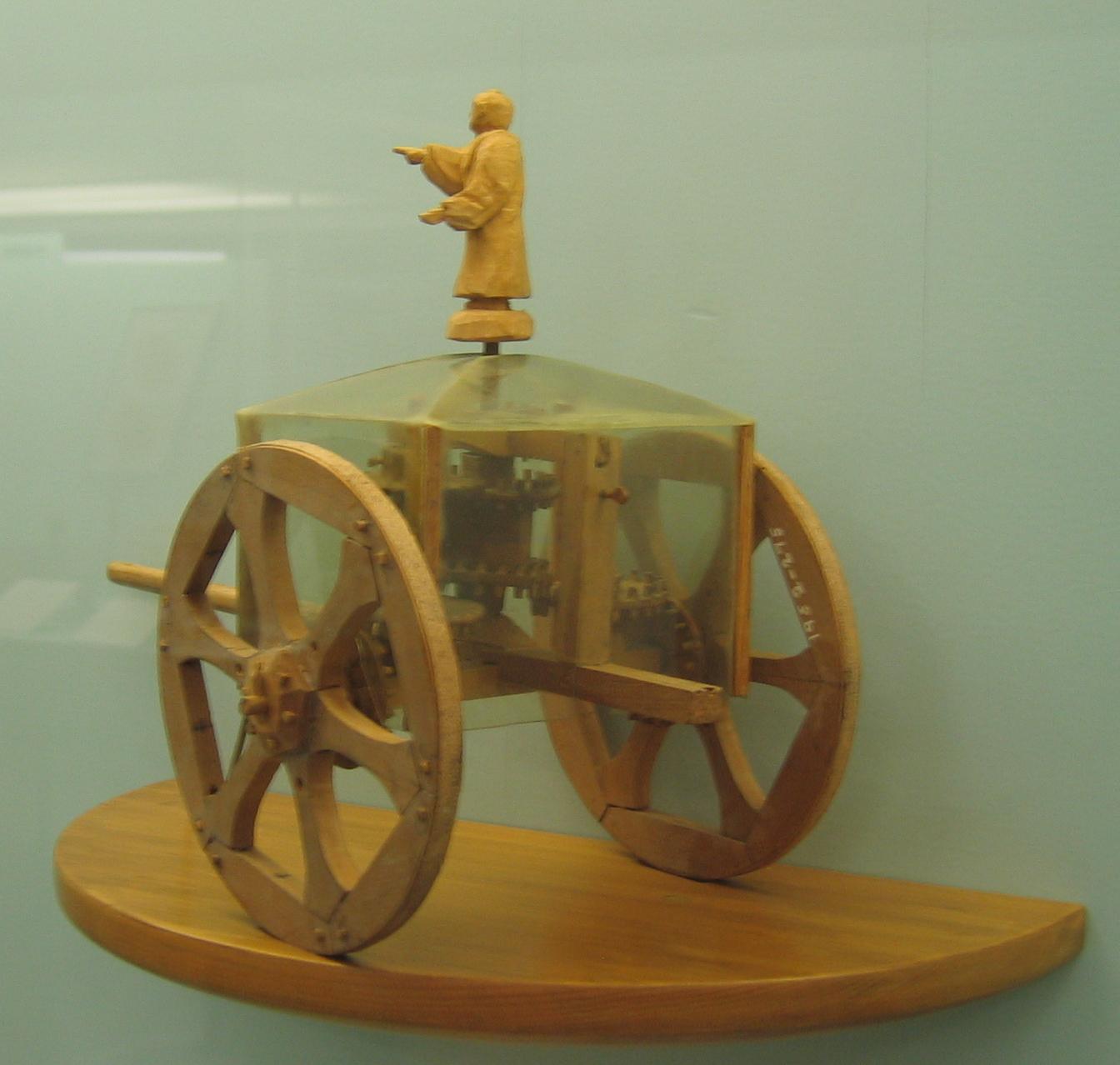
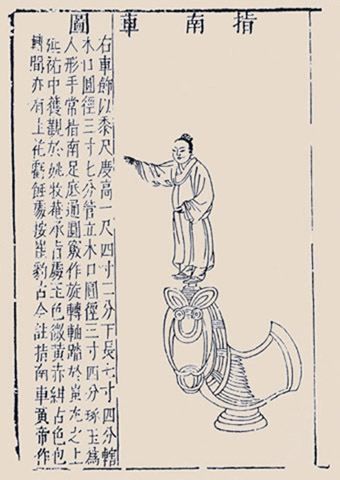
A wooden figure with one arm outstretched stood on a two-wheeled carriage and kept pointing south however the carriage turned. The Song Shu attributes the first one to the Duke of Zhou, and the Song Shi, in Yan Su’s 1027 memorial, to the Yellow Emperor. Both are legend. The first reliably documented chariot is Ma Jun’s, built for Emperor Ming of Cao Wei in the Qinglong era, usually dated 235, after Gao Tanglong and Qin Lang argued at court that no such device had ever existed.
The Song Shu records that it was lost again in the Jin troubles. Shi Hu had Xie Fei build one, Yao Xing had Linghu Sheng build another, and Liu Yu took Yao Xing’s in 417 when he entered Chang’an. That one was imprecise and needed hand correction at turns. A better one was built in the late 470s, and Wang Sengqian and Liu Xiu found it held its direction through many turns; Wikipedia credits Zu Chongzhi with building it. In the Song Shi, Yan Su says the method had been lost since the Tang and rebuilt it in 1027. Wu Deren presented a south-pointing chariot and an odometer cart in 1107, both first used at that year’s suburban sacrifice.
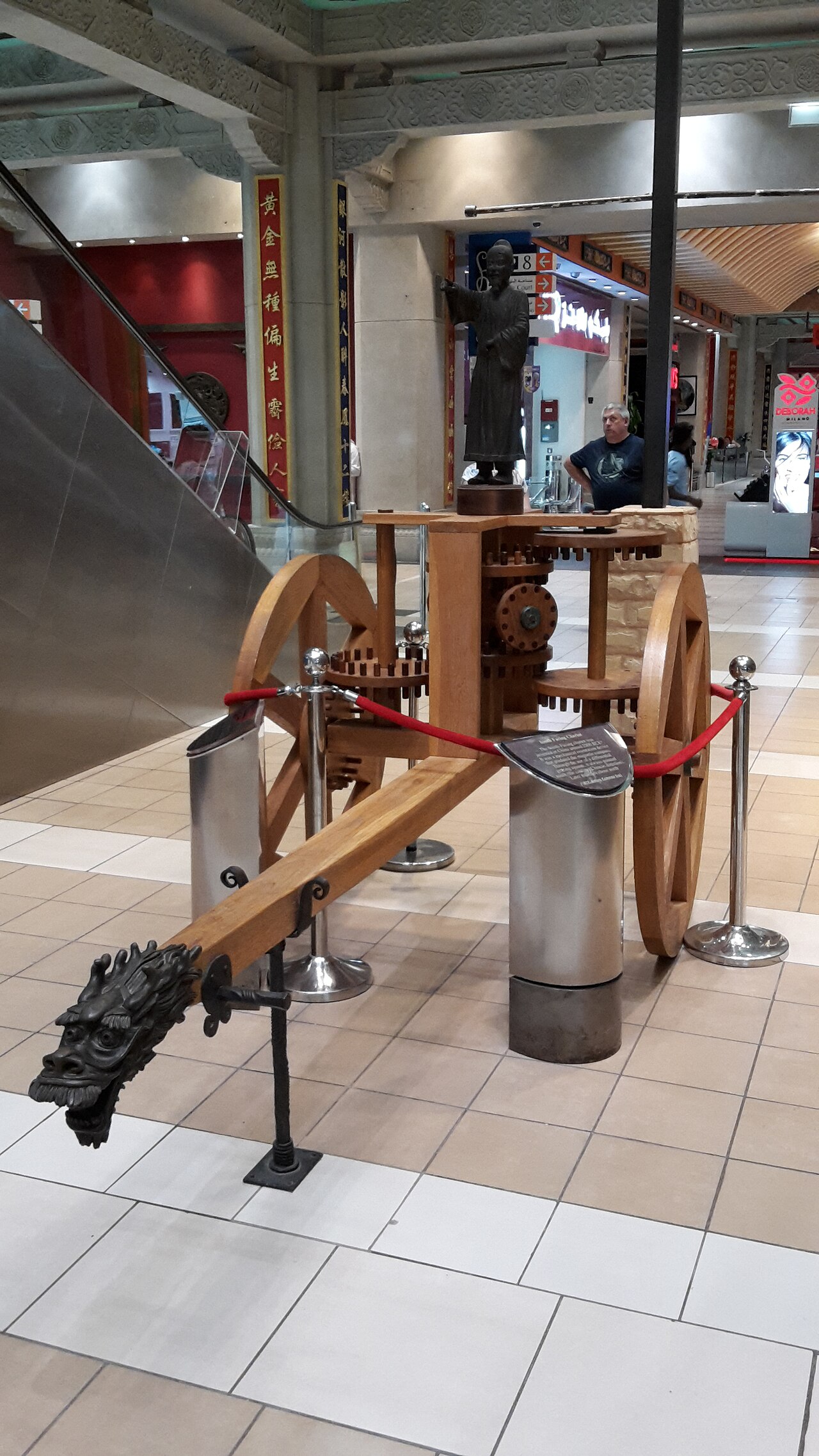
That is the last build the sources record. A south-pointing chariot with thirty drivers appears in a Jin procession list for 1153, with no statement on whether it worked, and Wikipedia says texts show intermittent use until about 1300, without naming them. No original survives. Most or all of the designs turned the pointer through gears driven by the road wheels, which accumulates error over distance. The Science Museum’s model, built about 1950 by George H. Lanchester, uses a differential gear; whether any ancient chariot did is a hypothesis.
Worth remembering
- At the Wei court, Gao Tanglong and Qin Lang argued that no south-pointing chariot had ever existed. Ma Jun built one.
- The Song Shu says the chariot Liu Yu captured at Chang'an in 417 was imprecise and had to be corrected by hand at turns.
- Wang Sengqian and Liu Xiu tested the chariot built in the late 470s and reported that it held its direction through many turns.
The people
-
Ma Jun — Builder of the first documented chariot, active c. 200–265
Court engineer of Cao Wei who completed a working chariot in 235 after officials argued such a device had never existed.
-
Wu Deren — Maker of the last documented chariot
Palace attendant who in 1107 presented designs for a south-pointing chariot and an odometer cart; both were first used at that year's sacrifice.
Gallery
Further reading
Sources
- The Song Shu states the Duke of Zhou first made the south-pointing chariot; it was lost in the late Han, Gao Tanglong and Qin Lang argued at the Wei court that no such chariot had existed, Ma Jun rebuilt it in the Qinglong era, it was lost again in the Jin troubles, Shi Hu had Xie Fei build one and Yao Xing had Linghu Sheng build one Wikisource (Song Shu, ch. 18)
- In 417 Liu Yu took Chang'an and obtained Yao Xing's chariot, which was imprecise and needed manual correction at turns. Near the end of the Shengming era (477-479) a new chariot was built, and Wang Sengqian and Liu Xiu found it exact through many turns; the text praises Zu Chongzhi Wikisource (Song Shu, ch. 18)
- The Song Shi records Yan Su's 1027 (Tiansheng 5) memorial tracing the chariot to the Yellow Emperor and noting the method had been lost since the Tang, then ordering its construction; and, in 1107 (Daguan 1), the palace attendant Wu Deren's chariot and odometer cart, both completed and first used at that year's suburban sacrifice. The chapter records no later making or use. Wikisource (Song Shi, ch. 149)
- The Jin Shi's Tiande 5 (1153) procession list includes a south-pointing chariot with thirty drivers, and says the Jin ceremonial system broadly imitated Song models; it does not say whether the chariot worked Wikisource (Jin Shi, ch. 41)
- Ma Jun completed his design in 235 after a court debate over whether such a chariot had ever existed Wikipedia
- Most or all chariots used road wheels to drive gears that turned the pointer against each turn, a form of dead reckoning in which errors accumulate; no examples still exist; the pointer was set south by hand at the start of a journey; texts show intermittent use until about 1300 Wikipedia
- The Science Museum holds a conjectural model of the chariot, built by George H. Lanchester and operated by differential gearing, dated about 1950, object 1952-275 Science Museum Group, London
Leave a flower to show you came, and remembered.