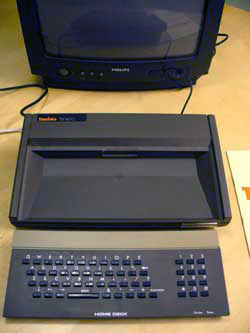
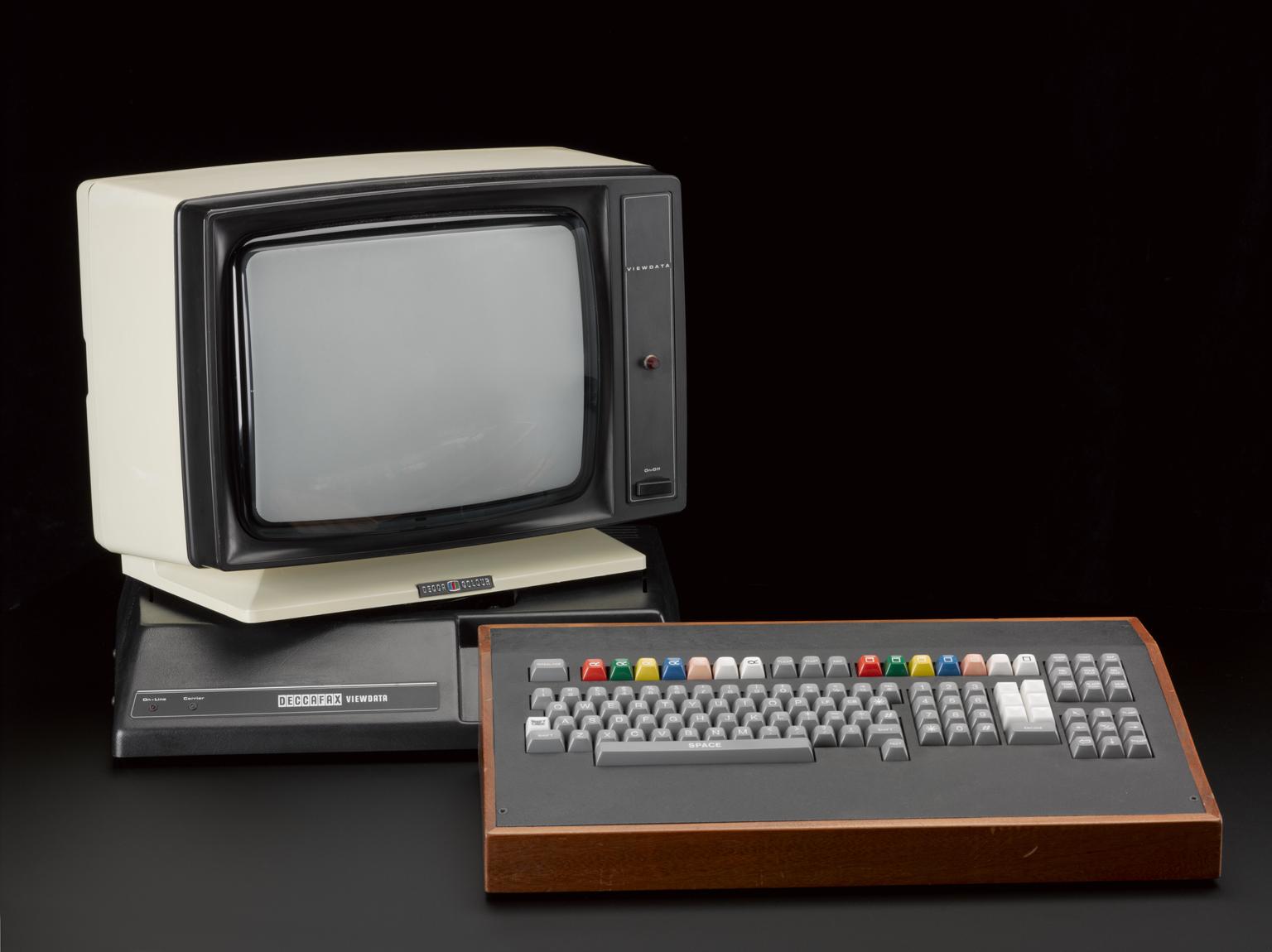
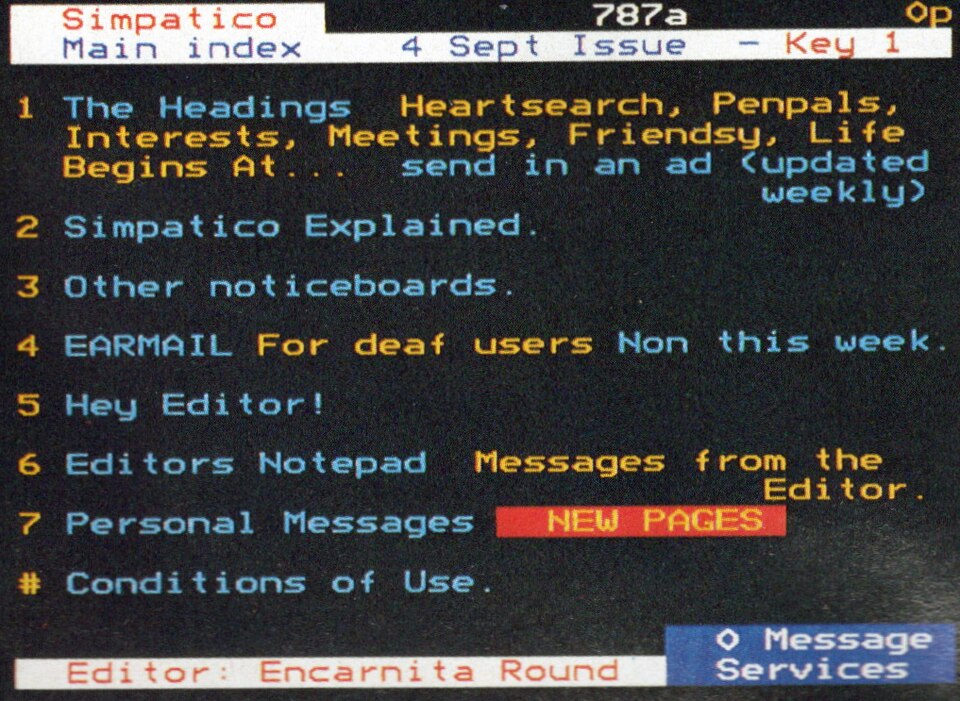
Prestel was the Post Office’s viewdata service: numbered pages of text and blocky colour graphics, delivered over an ordinary phone line to a modified television or a dedicated terminal. Samuel Fedida designed the system at Post Office research, a test service ran from October 1978, and the commercial service launched in September 1979. Subscribers browsed an inverted tree of pages, from general topics down to specifics, and read news, searched classified ads such as Simpatico, or did home banking through terminals like the one the Nottingham Building Society supplied. It never reached mass households: about 18,000 users in 1982 (3,000 residential), about 70,000 in 1986, and a peak of 95,460 attached terminals around 1988-89, with real subscribers fewer because businesses ran several terminals each.
Its most famous moment was a break-in. In November 1984 the Prestel mailbox of Prince Philip, Duke of Edinburgh, was breached. Robert Schifreen and Steve Gold were charged in 1985 with forgery, because Britain had no law against unauthorised computer access; Schifreen was convicted in April 1986 and fined 750 pounds. The Court of Appeal quashed the convictions in July 1987 and the House of Lords rejected the Crown’s appeal in April 1988. Parliament answered with the Computer Misuse Act 1990.
BT closed Micronet 800 in October 1991, and in 1994 it sold Prestel to a consortium of ViewInn, ICV and Michael Holland, which took over on 1 April 1994 as NewPrestel. The new owners aimed it at business financial data, moved it onto the Web in mid-1996 as Prestel On-line, and its internet service closed in 2002. The Post Office’s national viewdata service ended in 1994; the name lingered as a business-data reseller for another eight years. By the time the Web arrived offering the same pages without a closed network or a per-page charge, Prestel had already lost the audience it was built to reach.
Worth remembering
- Prestel pages sat in an 'inverted tree': you started at a general topic and drilled down numbered pages to specific information.
- In November 1984 the mailbox of Prince Philip, Duke of Edinburgh, was breached on Prestel. The prosecution that followed failed because no law covered it, and led to the Computer Misuse Act 1990.
- Micronet 800, a Prestel service for microcomputer owners, had over 10,000 members when BT closed it in October 1991.
The people
-
Samuel Fedida — Designer of the viewdata system
Post Office research engineer who designed the viewdata system that became Prestel.
-
Robert Schifreen and Steve Gold — Hackers of the Prestel system, 1984-85
Charged in 1985 with forgery over unauthorised Prestel access, including Prince Philip's mailbox. Convictions quashed on appeal in 1987; the Lords upheld that in 1988, and Parliament passed the Computer Misuse Act 1990.
Gallery
Further reading
Sources
- Prestel launched commercially in September 1979 after a test service from October 1978; engineer Samuel Fedida designed the viewdata system at the Post Office; about 18,000 users in 1982 (3,000 residential), about 70,000 in 1986, 95,460 attached terminals at the 1988-89 peak Wikipedia
- BT sold Prestel to an investment consortium led by ViewInn, ICV and Michael Holland; the consortium formed NewPrestel and took over running the service on 1 April 1994 Telecompaper
- Under its new owners the service refocused on financial data for businesses, moved to the Web in mid-1996 as Prestel On-line, and its internet service closed in 2002 Wikipedia
- Micronet 800, the Prestel microcomputing service with over 10,000 members, was closed by BT in October 1991 Wikipedia
- A security breach of Prince Philip's Prestel mailbox occurred in November 1984 Wikipedia
- Robert Schifreen and Steve Gold were charged in June 1985 under the Forgery and Counterfeiting Act 1981; Schifreen was convicted on 24 April 1986 and fined 750 pounds; the Court of Appeal quashed the convictions on 21 July 1987 and the House of Lords rejected the Crown's appeal in April 1988; the case led to the Computer Misuse Act 1990 Wikipedia
Leave a flower to show you came, and remembered.