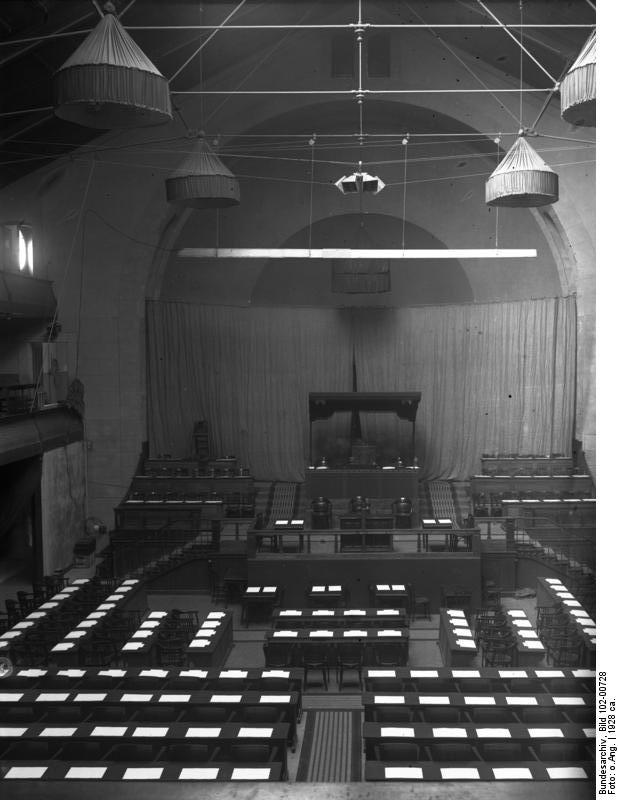
The League of Nations was an association of states created by the Covenant, which was signed on 28 June 1919 as Part I of the Treaty of Versailles. It came into being on 10 January 1920. The Council first met in Paris on 16 January 1920, and the first Assembly met in Geneva on 15 November 1920. Membership peaked at 58 in 1934 and 1935. The United States never joined: the Senate vote on the treaty on 19 March 1920 was 49 to 35, short of the required two-thirds.
Its work ran through an Assembly, a Council and a Secretariat in Geneva, which had 707 staff in 1931 and moved into the purpose-built Palace of Nations on 17 February 1936. Japan and Germany left in 1933, Italy in 1937 and Spain in 1939, and the Soviet Union was expelled on 14 December 1939 for invading Finland.
The United Nations Charter came into force on 24 October 1945, and the two bodies overlapped for several months. The League’s last Assembly met in Geneva in April 1946 and ended on 18 April, passing a resolution that the League would cease to exist except for the liquidation of its affairs. A nine-member Board of Liquidation wound up the accounts until 31 July 1947. The Palace of Nations and the League’s archive passed to the United Nations. The UN Office at Geneva states that the United Nations “officially has no connection” with the League, and an Aarhus University study of the transfer says historians agree the UN did not want to be seen as the League’s successor while taking its buildings.
Worth remembering
- The United States never joined: the Senate vote of 19 March 1920 was 49 to 35, short of the two-thirds needed.
- Membership peaked at 58 states between 28 September 1934 and 23 February 1935. Japan and Germany left in 1933, Italy in 1937, and the Soviet Union was expelled on 14 December 1939 after invading Finland.
- The Secretariat had 707 staff in 1931, and moved into the purpose-built Palace of Nations in Geneva on 17 February 1936.
Gallery
Further reading
Sources
- Founded 10 January 1920; Covenant signed 28 June 1919 as Part I of the Treaty of Versailles; first Council 16 January 1920, first Assembly 15 November 1920; Palace of Nations from 17 February 1936 Wikipedia
- 58 members at peak (28 September 1934 to 23 February 1935); US Senate vote of 19 March 1920 was 49-35, short of two-thirds; Japan and Germany left in 1933, Italy in 1937, Spain in 1939; the Soviet Union was expelled 14 December 1939; the Secretariat had 707 staff in 1931 Wikipedia
- Final Assembly ended 18 April 1946 with a resolution that the League cease to exist except for liquidation; Board of Liquidation to 31 July 1947; assets including the Palace of Nations and archives passed to the UN Wikipedia
- UN Charter in force 24 October 1945; 'The United Nations officially has no connection with the League of Nations'; some assets such as the Palais des Nations were transferred to the UN United Nations Office at Geneva
- A Common Plan between the League Supervisory Commission and a UN committee confirmed the dissolution and the transfer of assets; nine-member Board of Liquidation; historians say the UN did not want to appear as the League's successor Aarhus University, Inventing Bureaucracy
Leave a flower to show you came, and remembered.