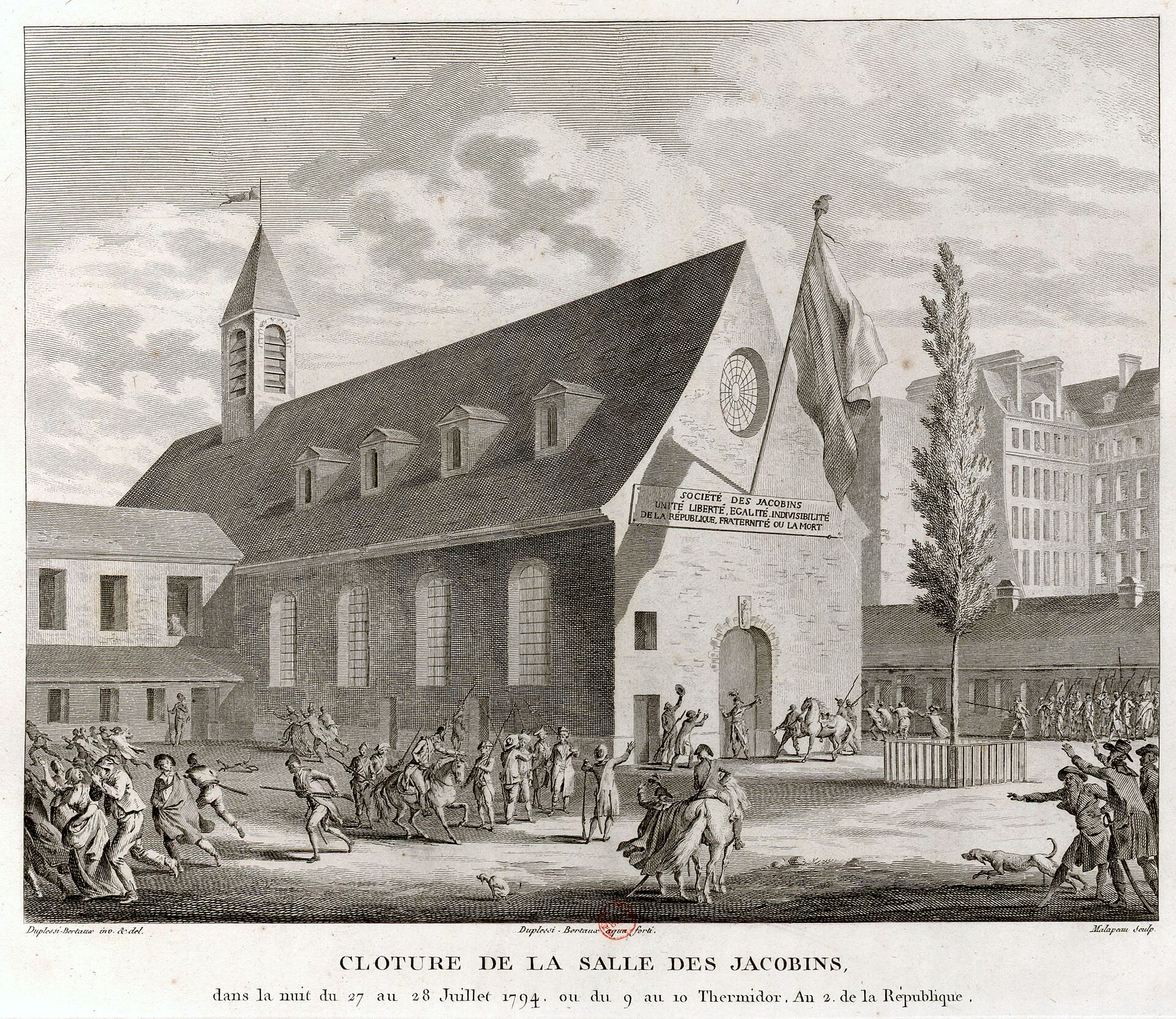
The Jacobin Club began in 1789 as the Club Breton, a group of Breton deputies at the Estates General. After the Assembly moved to Paris it took the name Société des amis de la Constitution in January 1790 and met in the refectory of the Dominican monastery on the rue Saint-Honoré, from which it got its nickname. It renamed itself Société des Jacobins, amis de la liberté et de l’égalité on 21 September 1792. It never held territory or ran a state: it was a club of deputies and citizens that took positions on the Assembly’s business. In July 1791 its conservative members left to form the Feuillants.
Its reach came through affiliates. By 10 August 1790 there were 152 affiliated clubs. By autumn 1791 French Wikipedia counts 442 Jacobin societies against 60 Feuillant and 110 undecided ones, and for year II it gives 5,500 affiliates. English Wikipedia, citing Brinton (1930) and Phillips (1911), puts the peak at no fewer than 7,000 chapters and about 500,000 members. The sources differ, and none gives a dated count.
After Robespierre’s fall on 9 Thermidor (27 July 1794) the hall was shut, and then reopened. On the night of 21 Brumaire year III the Committee of General Security closed it again, and on 22 Brumaire (12 November 1794) the Convention, without debate, decreed the club permanently closed. Within a year 93% of the provincial clubs had also closed. Later groups did not take over its seat or membership: the Club du Panthéon (November 1795 to February 1796) and the Club du Manège (6 July to 13 August 1799) were new bodies drawing on Jacobin politics, and both were suppressed within months.
Worth remembering
- 152 affiliated clubs existed by 10 August 1790, and 442 Jacobin societies by autumn 1791, against 60 Feuillant and 110 undecided societies.
- The conservative members left in July 1791 to form their own club, the Feuillants.
- In Paris the club met in the refectory of the Dominican monastery on the rue Saint-Honoré, next to the Assembly; the Dominicans' popular name gave the club its own.
Gallery
Further reading
Sources
- Founded 1789 as the Club Breton; renamed Société des amis de la Constitution in January 1790 and Société des Jacobins, amis de la liberté et de l'égalité on 21 September 1792; met in the refectory of the Jacobin monastery on the rue Saint-Honoré; at least 7,000 chapters and about 500,000 members at the peak; Committee of General Security closed the hall on 21 Brumaire and the Convention decreed permanent closure on 22 Brumaire (12 November 1794); 93% of the clubs closed within a year; Feuillants split in July 1791 Wikipedia
- Club breton founded June 1789 at Versailles; about 150 branches in late 1790; 442 Jacobin societies in autumn 1791 against 60 Feuillant and 110 undecided; 5,500 affiliates in year II; hall closed by the Convention on 12 November 1794 Wikipedia (French)
- 152 affiliated clubs by 10 August 1790; club closed after 9 Thermidor, reopening attempted, definitively closed 21 Brumaire year III; Club of the Panthéon founded 25 November 1795 and suppressed in February Encyclopaedia Britannica, 11th ed. (Wikisource)
- Club du Manège founded 6 July 1799 as a new club; closed by Fouché on Sieyès's orders on 13 August 1799 Wikipedia (French)
Leave a flower to show you came, and remembered.